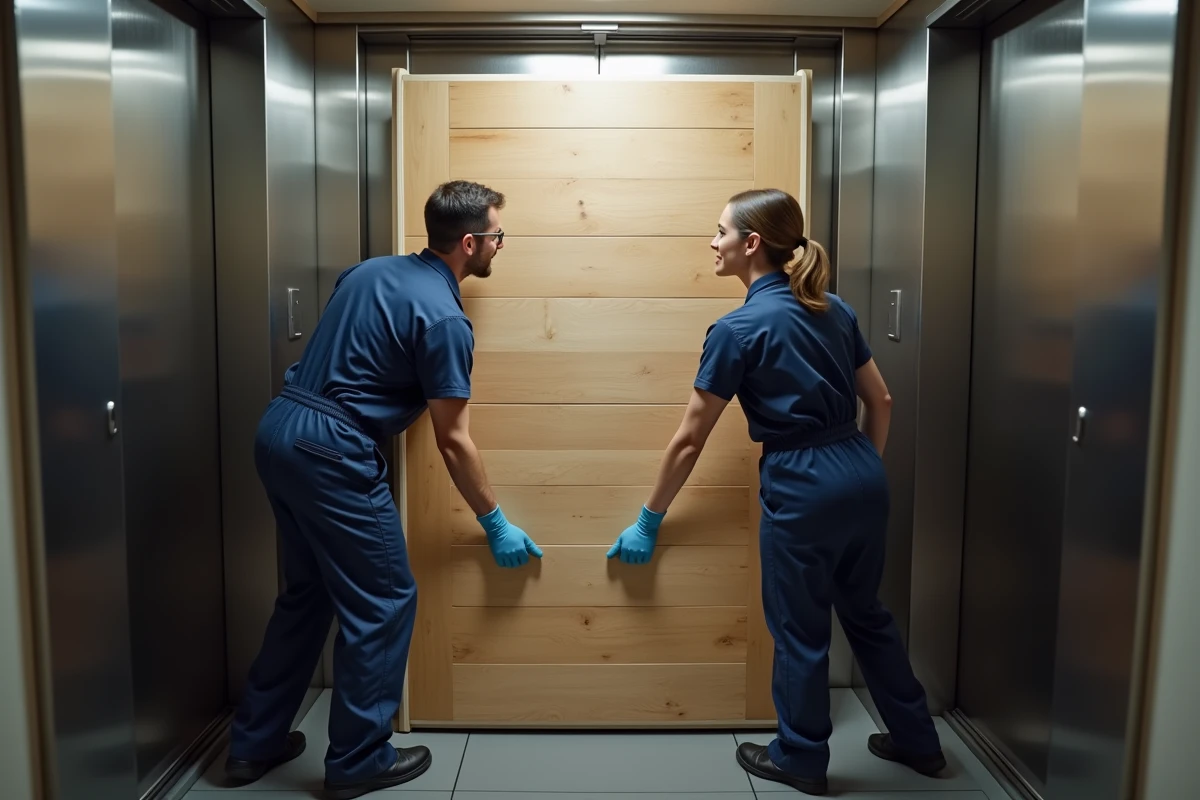
A 140 cm bed base does not fit in most French residential elevators. The interior depth of the most common cabins ranges from 1.00 to 1.40 m, with a width of 0.80 to 1.10 m. Therefore, asking about the size of the bed base means comparing the actual dimensions of the cabin to the overall dimensions of the frame, including the legs.
Interior dimensions of a residential elevator and actual maneuvering space
The dimensions displayed on the cabin plaque do not correspond to the usable space. The landing door reduces the passage width to a value often less than 80 cm. Once the bed base is tilted diagonally, one must also consider the ceiling height of the cabin, which is rarely more than 2.20 m.
We recommend measuring three dimensions before placing any order: door width, cabin depth, and ceiling height. A slatted bed base of 90×190 cm, for example, has a diagonal of about 210 cm. When tilted in a cabin that is 1.40 m deep and 2.20 m high, passage remains possible, but tight. With a frame of 140×190, the diagonal exceeds 230 cm, making maneuvering impractical in most standard cabins.
Choosing a suitable size for a bed base therefore requires thinking in terms of diagonal rather than raw length. Many deliveries fail because the customer compared the length of the bed base to the depth of the cabin without calculating the necessary tilt angle.
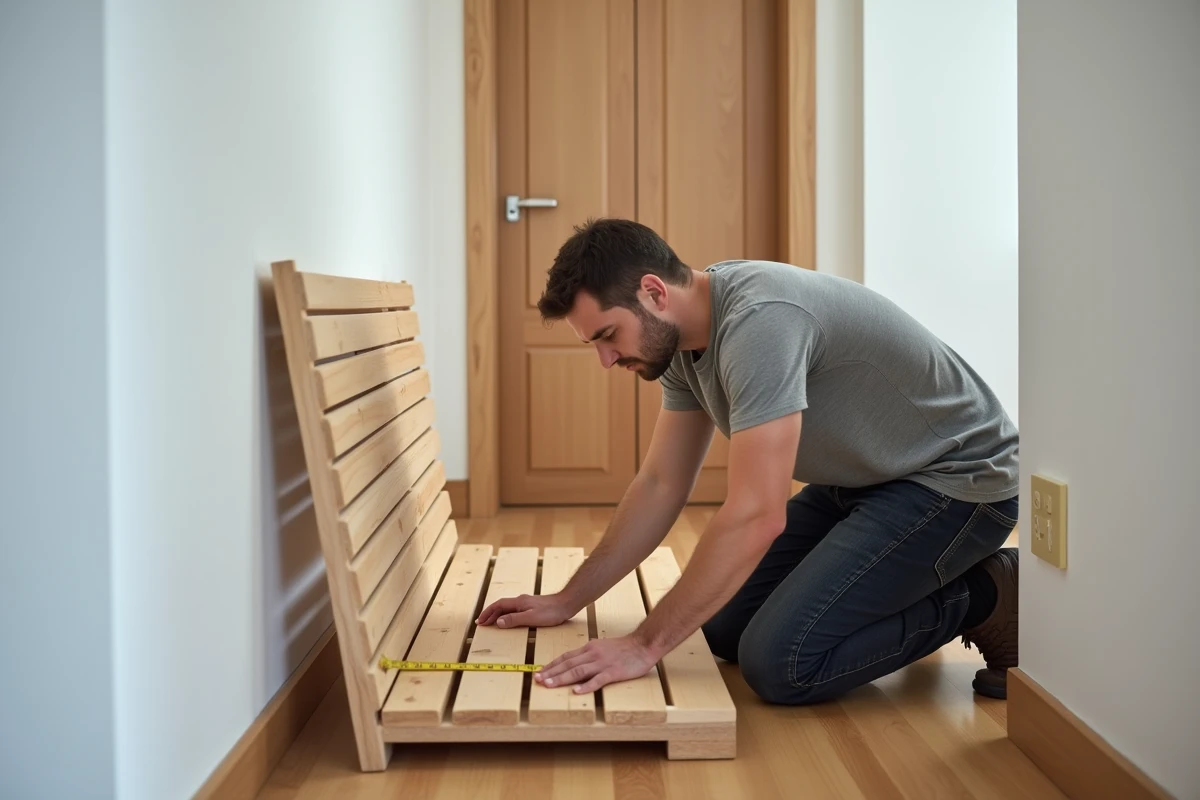
Flat-pack bed base or folding bed base: formats designed for elevator shafts
Bedding manufacturers have developed flat-pack bed bases where each component measures less than 120 to 130 cm. This format fits in nearly all residential elevators, including the narrowest cabins.
Two categories dominate the market:
- The flat-pack bed base to be assembled on-site, delivered in separate frame panels and slats. The longest package remains under 130 cm, solving the vertical transport issue.
- The folding bed base (or articulated), whose frame folds in two. Once folded, a 140×190 model does not exceed 140×95 cm, a format compatible with most cabins.
- The dismantled storage bed base, which combines a storage structure and a slatted frame, with components sized for elevator passage.
The monobloc upholstered bed base, on the other hand, remains the worst option for a building. Its rigid frame cannot be disassembled, and its diagonal consistently exceeds the capacity of a standard cabin that is 140 or 160 cm wide.
Frame rigidity after assembly
A properly bolted flat-pack bed base offers rigidity comparable to a monobloc. We observe that slatted models with a screwed central crossbar exhibit stable mechanical behavior, without lateral play, provided that the fasteners are tightened to the torque recommended by the manufacturer.
A well-assembled kit does not creak more than a single-piece bed base. Noise often comes from poorly clipped slat ends or insufficiently tightened screws, not from the kit design itself.
Two individual bed bases for a double bed: the most reliable solution
The configuration of two 80×200 cm bed bases combined to achieve a 160×200 sleeping area has become widely established in collective buildings. An 80 cm wide bed base can be stood up in any residential elevator, without tilting or diagonal calculations.
This approach has a mechanical advantage often overlooked: each bed base independently absorbs the movements of the sleeper, reducing the transmission of vibrations to the partner. Sleeping comfort is not compromised, provided a single mattress is used on top.
Issue of the central junction
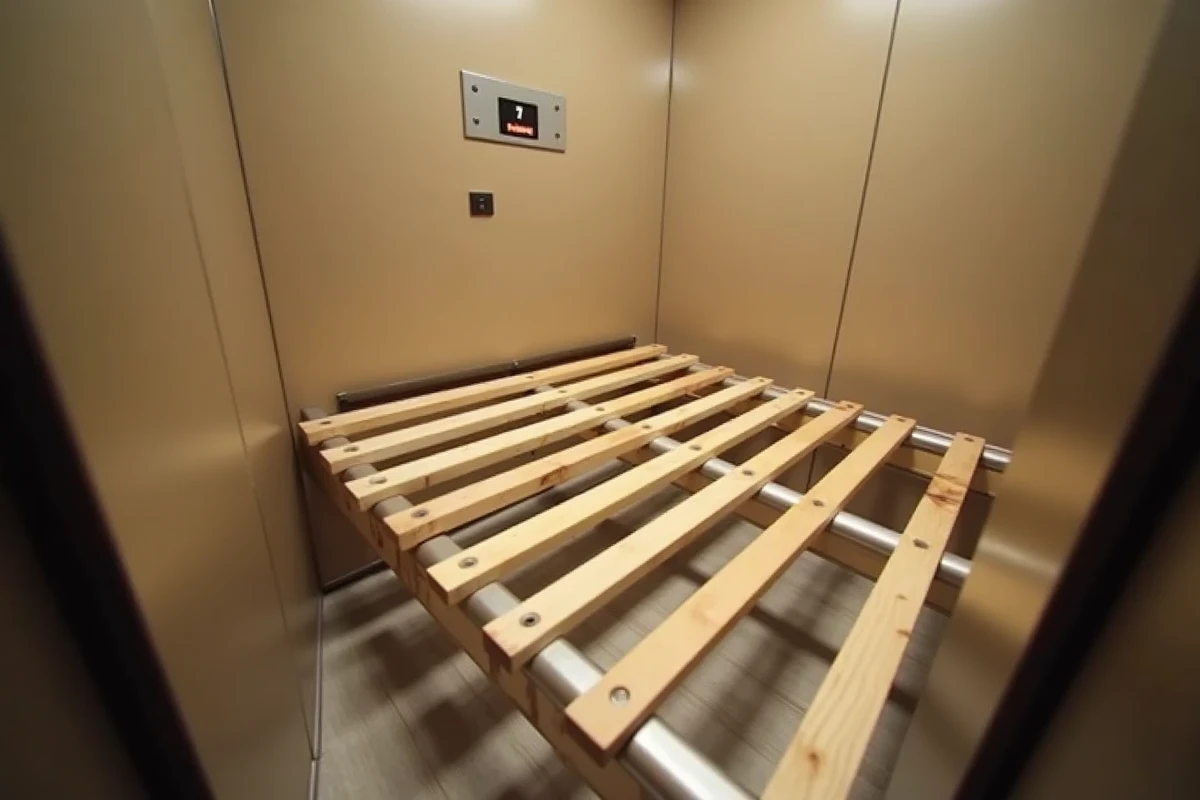
The classic complaint concerns the “bar” felt in the middle of the bed. This defect appears when the two bed bases are not secured together. A coupling kit (straps or metal brackets fixed under the frame) eliminates vertical offset and lateral slipping.
A mattress of at least 20 cm thick, whether foam or pocket springs, effectively masks the junction. Biconical spring mattresses, which are stiffer on the surface, conceal it less well.
140×190 bed base in a staircase: passage constraints and limits
When the elevator is too small or absent, the staircase becomes the only route. A monobloc bed base of 140×190 requires a landing of at least 150 cm deep to pivot. In Haussmannian buildings with winding stairs, the curvature radius is often insufficient.
The width of the staircase passage and the turning radius at the landing determine feasibility, not just the length of the bed base. A professional delivery person measures these two parameters before committing.
For a non-dismantlable slatted bed base, the only maneuvering option is to remove the slats from the frame to reduce thickness and lighten the whole. The frame alone, being thinner, can sometimes negotiate an impossible angle with the slats in place.
Summary of formats by cabin width
| Cabin Width | Max Monobloc Bed Base | Recommended Alternative |
|---|---|---|
| 80 cm | 70×190 (1 narrow place) | Kit or folding in 90 or 140 |
| 90 cm | 80×200 (1 standard place) | Two 80×200 combined for a 160 |
| 110 cm | 90×200 (1 comfort place) | Kit 140 or 160, folding 140 |
This table assumes a bed base transported upright, without tilting. With tilting, the ceiling height of the cabin becomes the limiting factor.
The choice of bed base format is made before ordering, measuring tape in hand, in the elevator cabin. Measuring the landing door, depth, and cabin height remains the only way to avoid costly logistical returns. For a double bed in a collective building, the pair of individual bed bases remains the safest configuration in terms of transport and comfort.