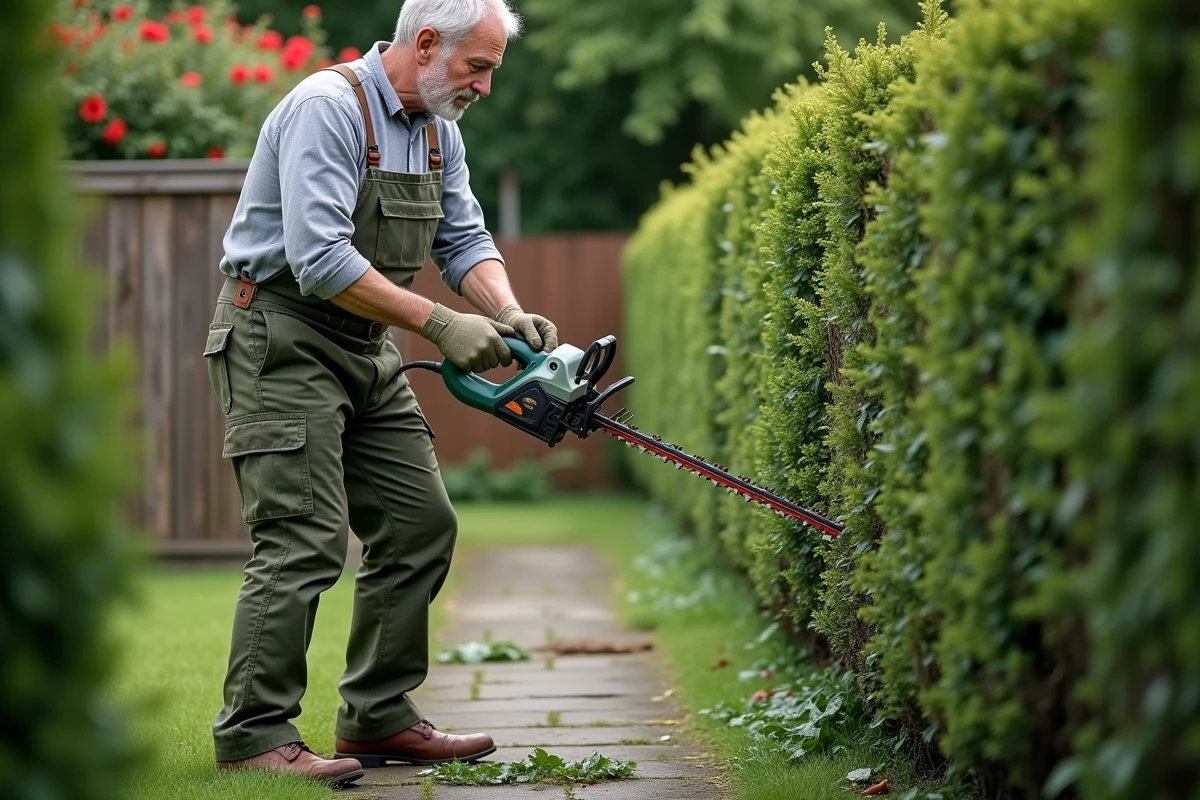
A hedge of thuja or cypress that overflows onto the sidewalk, a laurel that takes up half the path: we often find ourselves facing a mass of vegetation that has been allowed to grow for two or three seasons. Reducing the thickness of an overly large hedge is not just about trimming with shears and hoping for the best. The main risk is exposing old wood that cannot regenerate, especially on conifers.
Reducing a hedge on one side only: the method that preserves regrowth
When we want to decrease the width of a hedge without sacrificing it, the temptation is to cut from both sides at the same time. On a vigorous deciduous tree (hornbeam, privet, beech), this often works. On a thuja or Leyland cypress, it’s the best way to end up with a wall of brown branches.
The effective technique is to reduce only one side of the hedge per year. You cut back the branches on the chosen side, sometimes down to the trunk if the species tolerates it, and then let the vegetation recover for an entire growing season before tackling the other side. This two to three-year protocol is actually recommended by some networks of landscape artisans in French-speaking Belgium, under the name of “restructured” hedge.
By proceeding this way, the hedge retains a screen of foliage on the intact side, allowing it to continue photosynthesizing properly and nourishing the new shoots on the trimmed side. Here you can find our tips for thinning an overly wide hedge, which detail this gradual approach according to the species.

Thujas and conifers: why severe pruning leads to decline
Conifers like thuja pose a specific problem. Their old wood, lacking dormant buds, does not regenerate new green shoots if exposed. Cutting too deeply into the mass leaves permanent gaps.
Since 2023, several French municipalities have included explicit recommendations in their “zero pesticide” charters to no longer drastically reduce conifer hedges. The Lyon Metropolis mentions it in its Ecological Gardens Charter (2023 version), because these severe prunings often lead to decline within two to three years and high replacement costs.
Identifying the limit of green wood before cutting
Before taking out the hedge trimmer, you should spread the branches and identify the area where the green foliage stops. This is the line not to cross. On a typical thuja, this green band rarely exceeds a few dozen centimeters in thickness.
If the hedge has become excessively wide and the dead wood starts far from the trunk, the margin for maneuver is limited. In this case, it is better to accept a modest reduction each year rather than forcing it. The results vary on this point depending on the varieties of thujas, but the principle of caution remains the same.
Pruning period and bird protection for reducing a hedge
We often prune reflexively in summer, when the hedge is most overgrown. However, the ideal period for thickness reduction depends on the species and the nesting calendar.
- For deciduous trees (hornbeam, field maple), restructuring pruning is done at the end of winter, before bud break, when the structure of the branches is visible and the sap is not yet actively circulating.
- For evergreens (laurel, photinia), late summer or early autumn is preferred, after the second growth spurt, so that the cuts have time to heal before the cold.
- For conifers (thuja, cypress), light maintenance pruning is done in June and September, but strong reduction on one side is scheduled for late winter.
- In all cases, check for the absence of active nests before intervening. French legislation prohibits the destruction of bird nests, and a dense hedge often harbors them without us knowing.

Tools suitable for reducing the thickness of a thick hedge
Reducing the thickness of a hedge does not require the same equipment as simple maintenance pruning. You cut larger branches, sometimes woody ones, and the classic hedge trimmer quickly reaches its limits.
Pruner and pruning saw in addition to the hedge trimmer
For branches over two centimeters in diameter, a ratchet or gear pruner provides sufficient leverage without straining. A Japanese tooth pruning saw (pull-cut) allows access to the inside of the hedge and cleanly cuts the main branches you want to remove.
The hedge trimmer is used only for finishing, to even out the surface once the large cuts are made. Using a hedge trimmer to force through hard wood damages the blades and produces ragged cuts that heal poorly.
Managing cutting waste
A thickness reduction generates a significant volume of branches. A garden shredder transforms this waste into reusable mulch at the foot of the hedge itself. This mulch retains soil moisture and nourishes the plant during its recovery phase, promoting the emergence of new shoots on the trimmed areas.
Responsibility and hedges encroaching on public pathways
Beyond aesthetics, an overly wide hedge poses a real liability issue. Since 2022, some home insurance policies in France explicitly state in their “third-party damage” clauses that the property owner’s liability may be engaged if the hedge encroaches on the public pathway and obstructs visibility, especially after a warning letter from the town hall that goes unanswered.
This is not a theoretical case. Municipal technical services regularly send reminders to residents whose vegetation overflows onto the sidewalk or obscures a traffic sign. Therefore, reducing the width of your hedge is also a legal obligation, not just a maintenance concern.
Scheduling a thickness reduction over two seasons, starting with the street side, allows for quick compliance while letting the hedge naturally regrow its foliage on the garden side. This is the most reasonable compromise between maintaining privacy and respecting the neighborhood.