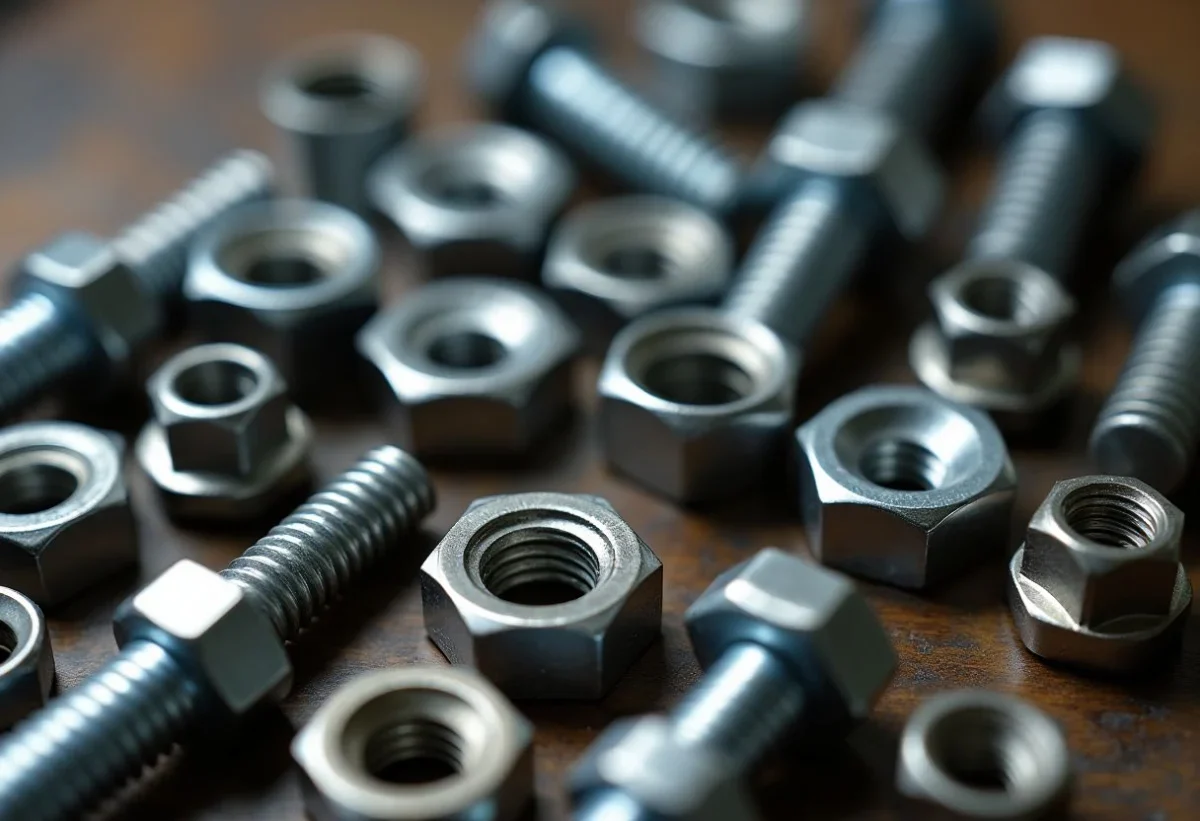
In the world of fastening systems, the lock nut stands out for its undeniable importance in the safety and reliability of mechanical assemblies. Whether in the automotive industry, aerospace, or household appliances, its role is central. Its ingenious design prevents spontaneous loosening due to vibrations or dynamic forces. This ensures the longevity and safety of structures. But what makes this component so indispensable? To understand this, it is essential to study its function, the different types available, as well as the materials used for its manufacture.
Operation and principles of the lock nut
The lock nut plays a crucial role in maintaining mechanical connections under tension. Its mechanism is based on simple yet effective principles, ensuring a durable fastening even under extreme conditions.
- Vibration resistance: Lock nuts are designed to withstand vibrations and movements that could lead to the unintentional loosening of the fixed elements. Their design generally incorporates a nylon piece or a metal ring that creates additional friction.
- Maintaining structural integrity: By keeping the parts in place, they ensure that the structure remains intact, even under high pressure or tension.
- Increased reliability: Thanks to their design, these nuts offer unmatched reliability, essential for critical applications.
Different types of lock nuts
There are several types of lock nuts, each suited for specific uses and environments. Each has particular characteristics that meet distinct needs.
Crimp nuts are often used for permanent assemblies. They require specific tooling for installation. The self-locking nuts, on the other hand, are equipped with a nylon ring inserted into the head, providing increased friction during tightening. Finally, the base nuts have a wide base that distributes pressure, ideal for irregular surfaces.
Materials used in the manufacture of lock nuts
The materials chosen for the manufacture of lock nuts determine their durability and effectiveness. It is therefore crucial to understand the properties of these materials to select the right lock nut for each application.
Stainless steel: This material is valued for its corrosion resistance and robustness. It is ideal for outdoor or industrial environments. Aluminum offers unmatched lightness, although it is less durable than steel. For applications requiring thermal resistance, titanium or special alloys are preferred.
Practical applications and uses of the lock nut
Lock nuts are used in a multitude of applications, demonstrating their versatility and importance in various sectors.
- Automotive industry: In this industry, every element must be secured to prevent accidents. Lock nuts ensure reliable fastening of essential parts.
- Aerospace: Due to the intense forces experienced by aircraft, the use of robust fasteners like lock nuts is essential for the safety of structures.
- Construction: Whether for securing beams or decorative elements, lock nuts ensure that fastenings do not loosen over time.
In a world where reliability and safety are paramount, the lock nut plays a key role. Thanks to its various applications and its ability to keep assemblies securely fastened, it remains an indispensable component in many sectors. Understanding its characteristics, materials, and uses allows for a better grasp of its importance and informed choices for all kinds of projects requiring secure fastenings.