When you push open the doors of a Carrefour hypermarket, your gaze catches an omnipresent logo: on the cart, the facade, the receipt, the mobile app. Two colored shapes, a white background, and yet most customers overlook a central graphic detail. This symbol, designed in the 1960s, relies on a principle of negative space that makes it a textbook case of visual identity design in France.
The hidden C of the Carrefour logo: a precise graphic mechanism
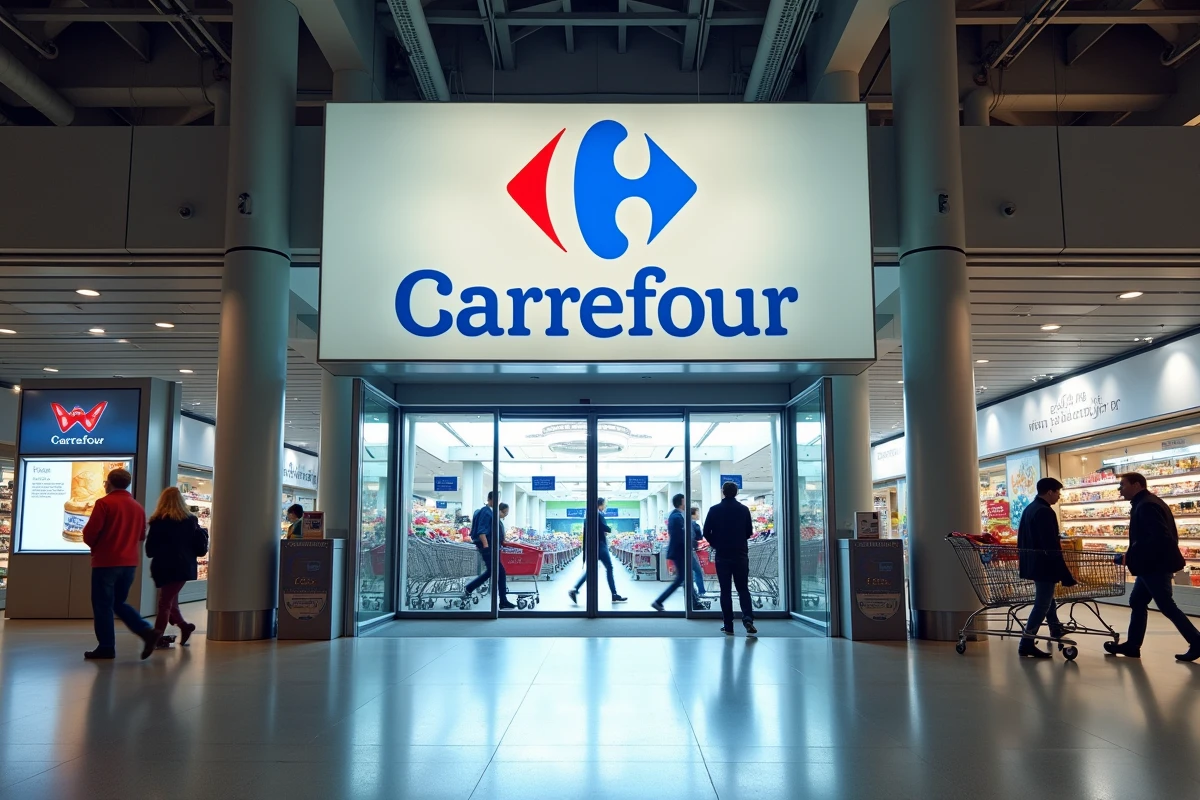
The logo operates on a trick that graphic designers call negative space. Two opposing arrows, one red pointing left, the other blue pointing right, frame a white area. This area, when looked at closely, forms the letter C, the initial of Carrefour.
This is not an accident. Jacques Daniel, the designer who created this logo in 1966, constructed the composition so that the eye first perceives the colored arrows, then gradually discovers the hidden letter. The brain processes solid shapes before those created by empty space, producing a delayed surprise effect.
To understand the origin and meaning of the Carrefour logo, one must look at what the arrows represent beyond the simple hidden letter. The red arrow points left (the past), the blue one points right (the future). This temporal duality reflects a brand positioning that claims both its roots and its ability to project forward.

Blue, white, red colors: a deliberate French anchoring
The color choice is far from trivial. The three colors of the French flag structure the logo: the blue and red of the arrows frame the central white. For a brand born in Annecy in 1959, founded by Marcel Fournier and the Badin-Defforey family, this national anchoring served to mark a strong local identity in the face of a commercial model inspired by American self-service.
This tricolor also acts as a signal of trust in the food sector. French retail brands have historically played this card, and Carrefour has integrated it directly into the very structure of its symbol, not on the periphery.
A palette that ages well
Where other logos have undergone radical color redesigns over the decades, Carrefour’s has retained its tricolor base. Adjustments have focused on the exact shades of blue and red, the thickness of the lines, and the typography of the word “Carrefour” below, but the blue-white-red structure has never been called into question.
From store sign to digital ecosystem: how the logo has changed roles
In 1966, the logo served to identify a physical point of sale. Today, it appears on platforms that Marcel Fournier could not have imagined:
- The Carrefour mobile app, where the symbol serves as a navigation marker between online shopping, promotions, and product scanning
- The Carrefour Club Card and the PASS Card, where the logo links the distribution activity and the group’s financial services
- The “Act for Food” campaigns, where it functions as an umbrella brand covering the retailer’s food commitment
This extension poses a concrete technical constraint. A logo designed for a storefront several meters long must remain legible on a smartphone screen just a few centimeters wide. The negative space of the C remains identifiable even in small format, validating the robustness of the original design.
Umbrella brand and store formats
In recent years, Carrefour has pushed a unified brand universe around the single word “Carrefour,” reducing the place of sub-brands like “Market” or “City” in certain communication materials. The logo then plays a unifying role: the same symbol for the hypermarket, the convenience store, the drive, and the bank.
Reactions vary on this point. Some branding analysts believe that this unification strengthens memorization, while others argue that it muddles the reading of formats. The logo, however, remains the visual thread.
Carrefour logo and popular culture: the phenomenon of “secret logos”
The Carrefour logo belongs to a category that fascinates on social media: logos with hidden details. On TikTok and Instagram, videos showing the “revelation” of the C between the arrows accumulate considerable view counts. Carrefour thus joins FedEx (with its hidden arrow between the E and the x) in the pantheon of visual identities that generate spontaneous engagement.
This viral phenomenon transforms a passive brand asset into a free communication tool. Each “discovery” video exposes the logo to an audience that has not crossed the threshold of a store. For a retail brand, this is a form of notoriety that traditional advertising struggles to replicate.
- “Did you know” type videos about the Carrefour logo reach a young audience, often distant from the hypermarket
- The mechanism relies on cognitive surprise: it shows what the eye saw without understanding
- The effect works because the logo is omnipresent in daily French life, amplifying the feeling of “missing out”
A logo designed nearly sixty years ago continues to produce organic content on platforms that did not exist ten years ago. The robustness of a graphic design is also measured by its ability to generate conversation without being altered. The white C of Carrefour meets this criterion with an effectiveness that few French brands can claim.